BMW's next-generation lithium ion cell will power the automaker's Neue Klasse electric vehicles
Urvaksh Karkaria
Simon Erhard
MUNICH — BMW Group is developing a battery cell that promises to go farther, cost less and be gentler on the planet.
The new lithium ion cell will power BMW's next-gen Neue Klasse electric vehicles.
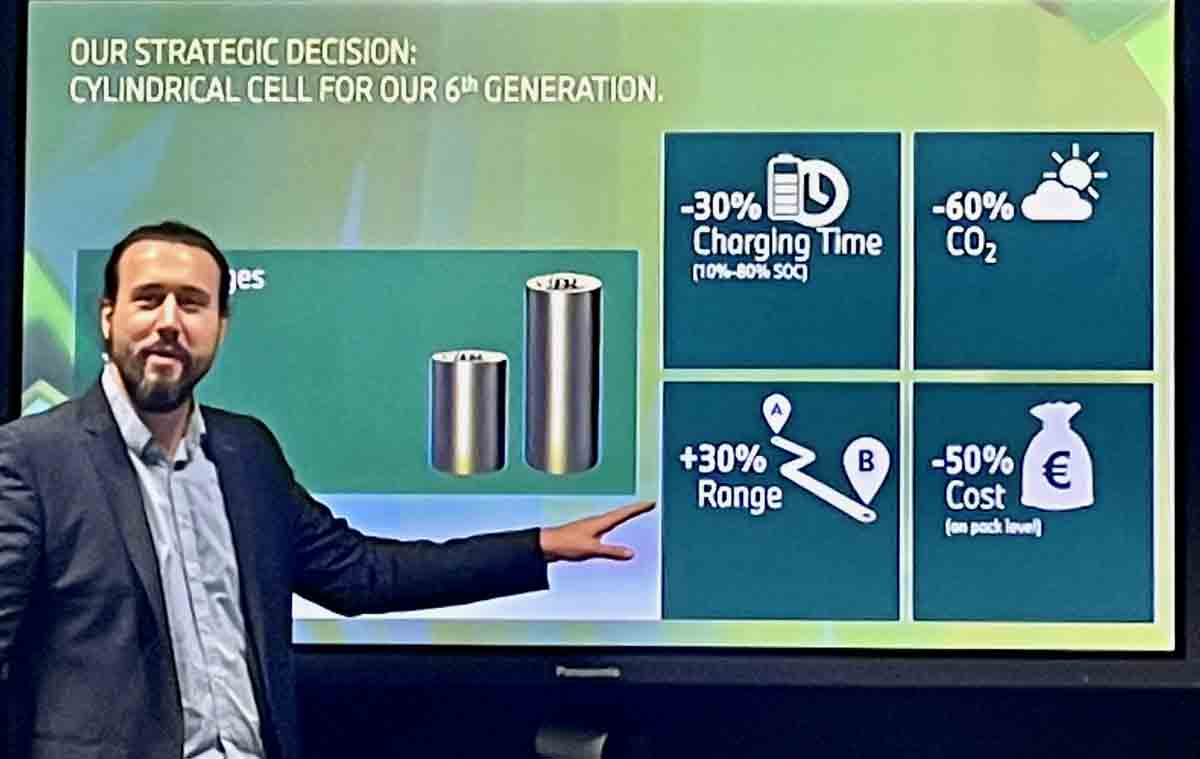
The so-called Gen 6 battery, under development at the BMW Group Battery Cell Centre of Excellence here, delivers up to 30 percent greater driving range than the current generation, according to the company.
A key to the performance is the battery cell's cylindrical shape, said Simon Erhard, who helps lead Gen 6 development at BMW Group.
While current BMW batteries feature prismatic cells configured in modules bolted together to form a pack, the next-gen design ditches the modules. Its new cell-to-pack design allows more power-packing cells to be squeezed into the same battery footprint. The Gen 6 battery has a diameter of 46 millimeters.
"Energy density is much higher than before," Erhard told a group of journalists at a media briefing this week. "You can put more cells into the battery pack."
Maximizing energy density also reduces battery weight and cost.
BMW said the new battery pack is 50 percent less expensive. That will be essential to achieving price parity with combustion engine vehicles, as the battery pack accounts for about 40 percent of an electric vehicle's cost.
GENERATION 6 BATTERY
BMW's next-generation lithium-ion battery promises:
-
30% increase in energy efficiency and recharging speed.
-
50% decrease in cost
-
60% reduction in carbon emissions
Erhard said the "cell-to-chassis" design allows the battery pack to be mounted directly into the vehicle frame, improving chassis stiffness and ride quality.
"With Gen 6, we're integrating cylindrical battery cells straight into the vehicle," he said. "It's now part of the body."
BMW is further refining the design.
"The main challenge is to achieve the right compromise between stiffness and flexibility," Erhard said. "The most integrated [design] would be where the vehicle floor is the upper part of the battery pack."
BMW isn't the only automaker experimenting with structural batteries.
In the newest version of its Model Y, Tesla has a similar cell-to-pack concept in which cylindrical battery cells are bonded with structural adhesive, sandwiched between two metal plates and connected to the front and rear cast-metal structures of the crossover.
The Gen 6 battery promises to go farther on a single charge and recharge faster. Recharging from 10 to 80 percent is 30 percent quicker.
The cell itself is more sustainable, as it uses more nickel and silicon and less cobalt. BMW said the cathode in its battery cell boasts 50 percent less cobalt, while the anode has 20 percent less graphite.
The cells will be produced with renewable energy and partly use recycled cobalt, nickel and lithium to cut production-related carbon emissions by 60 percent.
Erhard said the technology maximizes energy efficiency with "smart integration while keeping safety high and a low carbon footprint."
BMW will build several Neue Klasse electric crossover models at its U.S. factory in Greer, S.C., starting mid-decade. BMW has said it intends to produce at least six electric models there by 2030.
To supply those vehicles, BMW has tapped Envision AESC to build Gen 6 battery cells at a new factory in South Carolina. The factory will have an annual capacity of up to 30-gigawatt hours — able to supply enough batteries for 300,000 EVs annually, according to AutoForecast Solutions.
But even as BMW readies its next EV batteries for market, it is exploring new technologies such as solid-state batteries.
Erhard said innovation in lithium ion battery technology is peaking.
"From an energy density point of view," he said, "we're facing the [limits] of lithium ion cell chemistry in industrialized applications."
Reuters contributed to this report.
Source:Automotive News